ShipFast vs Makerkit vs Supastarter vs Vibecarbon: What Comes After the Starter Kit?
The best SaaS boilerplates of 2026, compared honestly, and the question none of them answer: who runs your app on day thirty? A guide for builders deciding between a starter kit and something more.
SaaS starter kits won the argument. Nobody hand-builds another login page, another
Stripe integration, another pricing table: you buy a boilerplate, and week one of your
product is somebody else's finished work. ShipFast turned that idea into a category;
Makerkit and Supastarter refined it. If you're choosing between them, you're already
making a smart decision.
But the starter kit category has a boundary (a deliberate one), and knowing exactly
where it sits is the difference between choosing well and being surprised. This post
compares the three most popular kits honestly, on their own terms. Then it asks the
question that sits just past the category's edge: what happens after the starter
starts you?
Disclosure, as always: this is the Vibecarbon blog. The three kits below are good
products, each credited with what it genuinely does best.
The three worth comparing
ShipFast ($199–$349, one-time) is the category's name brand,
and it earns the reputation: a Next.js codebase with sign-in (Google, magic links),
payments (Stripe or Lemon Squeezy), a database (MongoDB or Supabase), email, a blog,
and the landing-page bones, built by Marc Lou and battle-tested across more than
twenty of his own products. Its whole personality is speed: from purchase to a live
landing page in a weekend. Nothing else on this list matches that first-48-hours
feeling.
Makerkit ($299, one-time) is the architect's choice: the
strongest multi-tenancy story in the category (personal accounts, organizations, or
both, as a documented switch), a plugin system that keeps your changes out of the
core, and, notably, real AI tooling, including an MCP server that lets assistants
like Claude and Cursor work with the codebase in a structured way. If you're building
B2B with teams and roles, this is the most serious starting point of the three.
Supastarter (free starter; $299–$599 for the full kit)
is the pragmatist's pick: a solid Next.js + Supabase foundation with multi-tenancy and
payments, a genuinely useful free tier to try before buying, and AGENTS.md
guidelines tuned for Cursor and Claude Code, a sign its author understands who's
actually writing code in 2026.
All three are one-time purchases, all three are actively maintained, and all three
will save you weeks. If a starter kit is what you need, you'll be in good hands with
any of them.
The boundary they share
Here's what all three have in common, stated without judgment: at the end, you're
holding a repository. A very good repository. And everything after it is you.
Deploying it: you. The usual path pairs a hosted platform for the app with a hosted
database underneath (excellent services, each with its own account and dashboard).
Backups that have actually been restored: you. Upgrades across the stack: you. The
day your product needs a second region, or needs the database to survive a bad day:
also you. The kits are upfront about this: operations was never the product. Their
product is captured perfectly in the category's name: they start you.
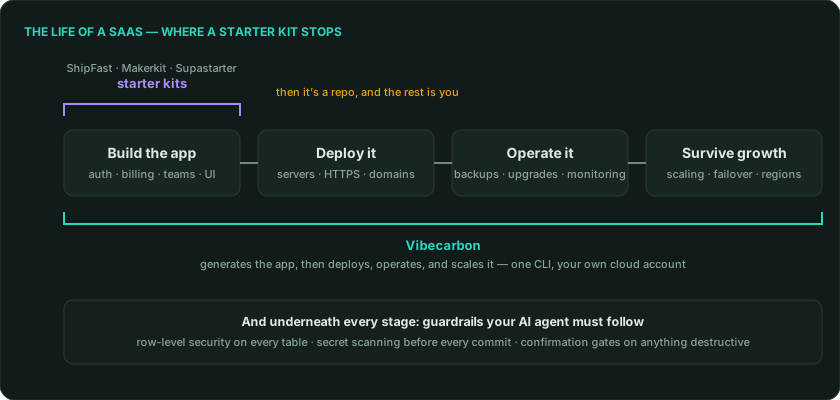
The life of a SaaS. Starter kits are stage one. Then it's a repo, and the rest is
you.
And there's a second boundary, newer and sharper. Makerkit's MCP server and
Supastarter's AGENTS.md deserve real credit: both understand that an AI agent is
probably writing much of your code now. Both are meaningful steps, and ahead of most of the industry. Vibecarbon simply
takes the next one: given what agents do at speed,
guidance the agent reads is good. Rules the agent cannot break are better.
What "on steroids" actually means
Vibecarbon isn't a fourth entry on the starter kit list. It's what the list is missing
a column for.
vibecarbon create generates what the kits sell: sign-in with OAuth and magic links
and two-factor, billing across Stripe, Paddle, and Polar, teams, an admin panel,
transactional email, blog, docs, translations. And then it keeps going, because the
generated app is only half the product. The other half is the CLI that runs it for the
rest of its life:
vibecarbon deploy rents and configures servers in your own cloud account, on
the provider you choose, with HTTPS, a private (self-hosted) Supabase, and
scheduled backups, in one command. No hosted platform in the middle, no second
dashboard, no meter.vibecarbon backup and restore are first-class, rehearsable commands, not a
wiki page you write later.vibecarbon scale and failover carry you from one small server to
multi-region setups that survive a data center going dark, with our measured
recovery times published openly.- And the guardrails are enforced, not suggested. Row-level security (the
database itself refusing to show one customer another customer's rows) on every
table. A scanner that blocks secret keys from ever being committed. Confirmation
gates on anything destructive. Your agent doesn't get asked nicely; it gets stopped.
One more difference worth naming plainly, because this audience cares: the kits'
codebases live in private repositories you unlock by purchasing, a perfectly normal
model for their category. Vibecarbon's CLI and its template are publicly readable
before you spend anything: read first, decide second. The CLI is Fair Source
(FSL-1.1-MIT). Not open source, and we won't blur that. Every release becomes
MIT two years after it ships; the app it generates is MIT from day one, yours
outright. And the pricing runs the same direction as the kits, then further:
the Graphite license is free and covers single-server Compose deploys,
Kubernetes needs Graphene at $19 per project per month, and any HA mode needs
Fullerene at $39 per project per month.
The honest chooser
| Your situation |
Pick |
| Landing page live this weekend, validate the idea, iterate |
ShipFast |
| B2B app with organizations and roles, you'll own the ops yourself |
Makerkit |
| Want to try the code before paying anything |
Supastarter (free tier), or Vibecarbon, whose code is public |
| Want the app and its whole operating life: deploys, backups, scaling, failover |
Vibecarbon |
| Building primarily with AI and want guardrails enforced, not documented |
Vibecarbon |
| Committed to Vercel-style hosted platforms and happy there |
Any of the three kits |
The starter kit was the right answer to 2023's question: why is everyone rebuilding
the same app? Vibecarbon is an answer to 2026's: what if the app came with its whole
operating life, and guardrails your AI agent can't talk its way past?
If week one is your bottleneck, buy a kit; the three above are the right three. If
you'd rather skip week one and every operations week after it:
npm install -g vibecarbon, then vibecarbon create, and
start here.